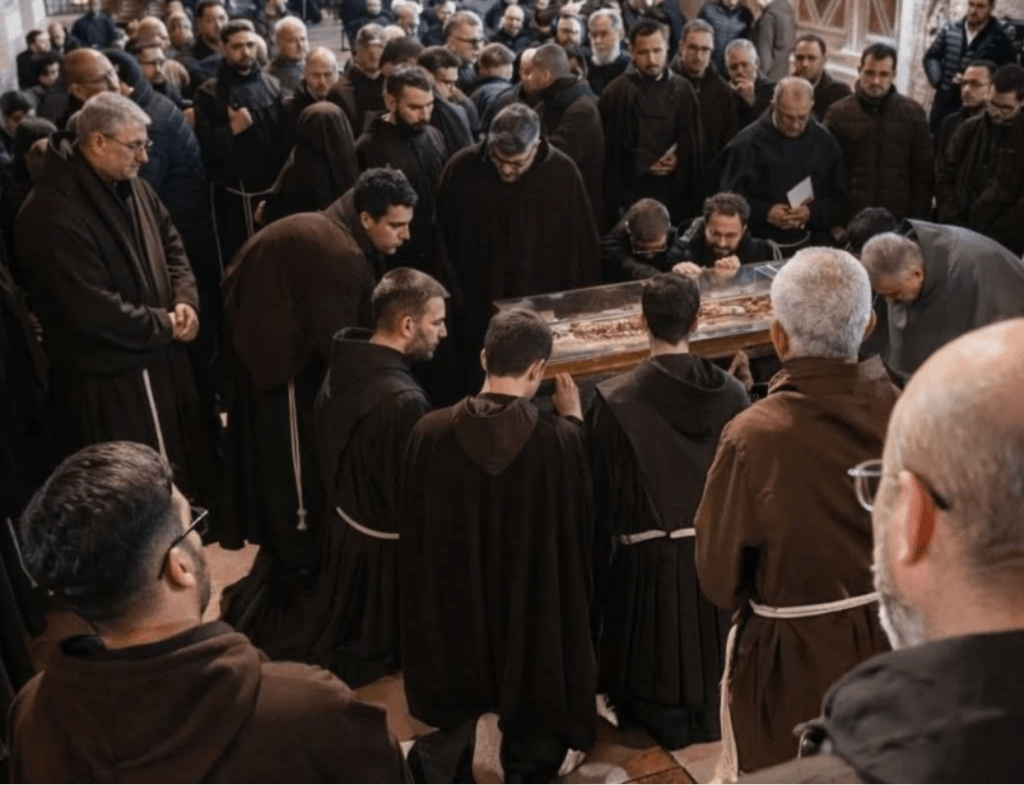
These days in Assisi the public exposition of the body of Saint Francis is taking place. For an entire month, thousands of pilgrims will pause before his remains. Estimates speak of approximately 18,000 people per day. The figure is striking. In a technological and disenchanted society, such large crowds still set out on pilgrimage toward the body of a saint who died eight centuries ago. For some, the phenomenon appears incomprehensible—a residue of archaic religiosity, a sign of superstition—while others cry out about the return of some vaguely defined “dark ages.”
And yet the veneration of relics—that is, the mortal remains of the saints—is not a marginal element of Christianity. It is a practice that runs through the entirety of its history and that remains alive today, just as in the earliest centuries. To attempt to understand it, without dismissing it with superficial judgments, means entering into the very heart of Christian faith, precisely at the point where the body becomes a true stumbling block to every attempt to reduce faith to a purely disembodied ideality.
In Christianity, the veneration of relics concerns not only the saints but—preeminently—also what is directly connected to the Lord Jesus and to the apostles. This practice, already attested in the early centuries, is rooted in a theological logic: if God acted in history by becoming incarnate, then what was touched by Him can become a living memory of salvation. The tradition carefully distinguishes different levels of veneration in order to avoid confusion or devotional excess: latria, the adoration due to God alone; dulia, the veneration given to the saints; and hyperdulia, the special veneration reserved for the Virgin Mary.
At the summit stand the relics of the Lord, which occupy an absolutely unique place. Since Christian faith professes the bodily resurrection of Christ and His ascension into heaven, the Church has never spoken of bodily relics of Jesus in the ordinary sense. The relics of the Lord are rather objects directly linked to His Passion and earthly life. Among the most venerated throughout history are the wood of the Cross (the so-called True Cross), the Holy Sepulchre in Jerusalem, the Titulus Crucis, and other instruments of the Passion. Their veneration is very ancient: already in the fourth century, after the discovery of the Cross traditionally attributed to Saint Helena, devotion to the Vera Crux spread throughout the Christian world. The meaning here is clearly Christological: it is not an object in itself that is honored, but the mystery of the Passion and redemption.
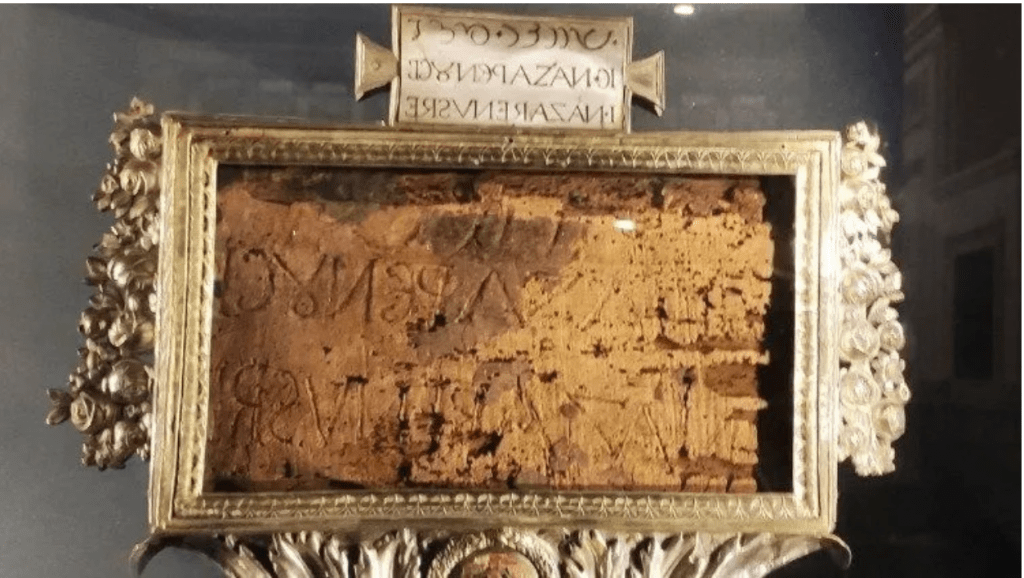
Immediately afterward, in a wholly unique position, stands the Virgin Mary. Catholic and Orthodox tradition agree that there are no bodily relics of the Mother of God. The reason is theological. From the earliest centuries, the conviction spread that she was assumed gloriously into heaven—a doctrine solemnly defined in 1950, yet rooted far earlier in the faith of the Church. For this reason, unlike other saints, we do not find her body or bones venerated in churches. There exist instead numerous so-called “contact relics” connected by tradition to her earthly life (such as the Holy House of Loreto or the veil of Mary venerated in both East and West).
The case of the apostles is different. Their veneration developed already in the sub-apostolic age. The tombs of Peter and Paul in Rome became places of pilgrimage as early as the second century. The same occurred for James in Jerusalem and, according to medieval tradition, for James the Greater in Compostela. The apostles are the original witnesses of the Resurrection, those in whom the paschal faith first took historical form. Their relics thus became reference points for ecclesial memory and for communion among local Churches.
Already in the second century, in the context of persecution, Christian communities carefully gathered the remains of martyrs. The Martyrdom of Polycarp recounts that the bones of the bishop of Smyrna were considered “more precious than costly stones and finer than gold” and were placed in a location where the faithful could gather for the annual commemoration. For the early Christians, the martyr was one in whom the following of Christ was lived to the shedding of blood; his body was therefore the trace of a life transformed by grace and given for the faith. It is no coincidence that, by the third century, the Eucharist was celebrated near the tombs of martyrs in the catacombs, where the memory of the witnesses of faith was inseparable from the paschal mystery.
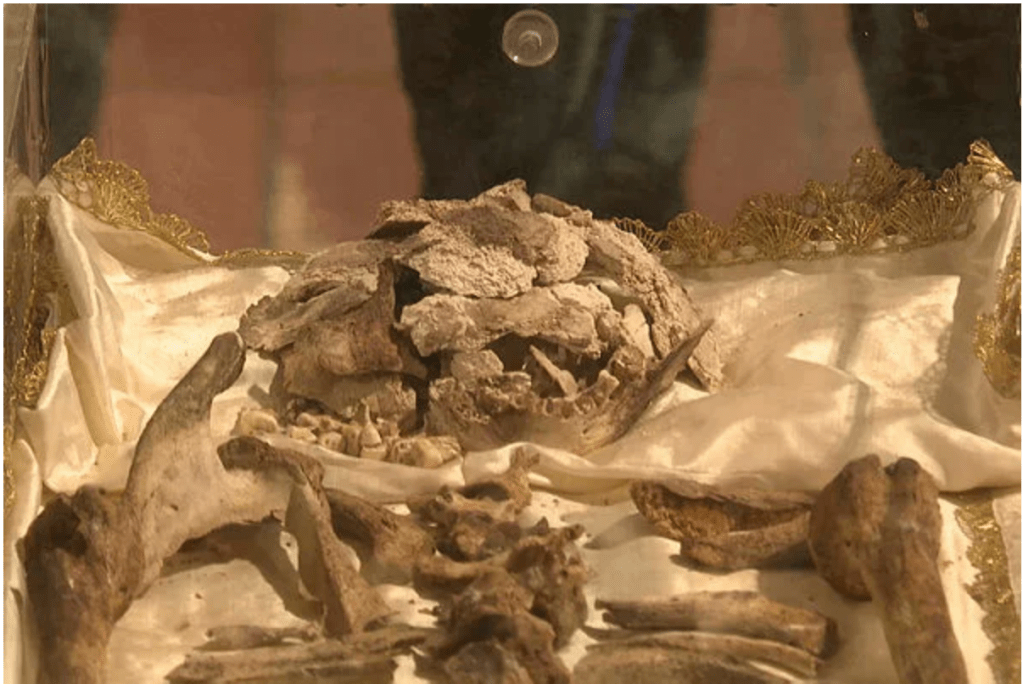
With the peace of Constantine in 313, devotion spread and became structured. Basilicas were erected over the tombs of apostles and martyrs; pilgrimages began; and, according to some sources, beginning with Saint Ambrose, the practice was introduced of placing relics of martyrs beneath altars. In the Middle Ages the phenomenon expanded extraordinarily, at times accompanied by abuses that led the Church to intervene with greater regulation, culminating in doctrinal clarification at the Council of Trent. Yet the principle remained unchanged: veneration is not adoration. Adoration (latria) belongs to God alone, while the saints (and the angels) are given honor (dulia) as friends of God and witnesses of His grace.
We must always remember that Christianity is the religion of the Incarnation, in which the reality of “the Word became flesh” stands at the center of faith. If God assumed human nature, then the body is not indifferent, and faith cannot be reduced to a purely interior or merely ideal experience. Paul expresses this forcefully when he writes: “Do you not know that your body is a temple of the Holy Spirit within you, whom you have from God?” (1 Cor 6:19). Within this horizon, the body of the saint appears as the place where grace was truly inscribed and incarnated in history. It is irreducible to a mere idea; it becomes a visible, bodily sign of God’s presence among His people.
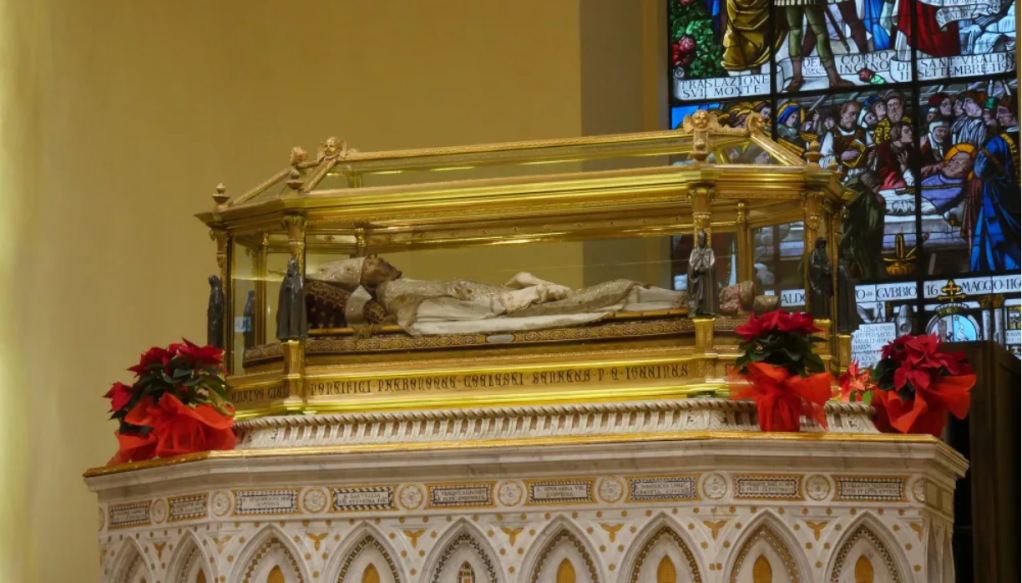
In Gubbio, for example, the incorrupt body of Bishop Saint Ubaldo Baldassini (†1160) has been venerated for centuries. Preserved in the basilica on Mount Ingino, it stands at the center of a devotion that intertwines faith and civic identity, as well as thaumaturgical practice and even exorcisms. In more recent times, the Lebanese monk Saint Charbel Makhlouf (†1898) has drawn the attention of both faithful and scholars. After his death, the exhumation of his body and the phenomena reported at his tomb, together with numerous healings attributed to his intercession, made the monastery of Annaya one of the principal pilgrimage sites in the Middle East. The Church, with prudence, does not consider incorruptibility an automatic criterion of sanctity; what may be recognized in canonical processes are healings judged scientifically inexplicable. Nevertheless, in the consciousness of the faithful, these bodies remain powerful signs of a holiness that has touched the flesh and woven itself into history.
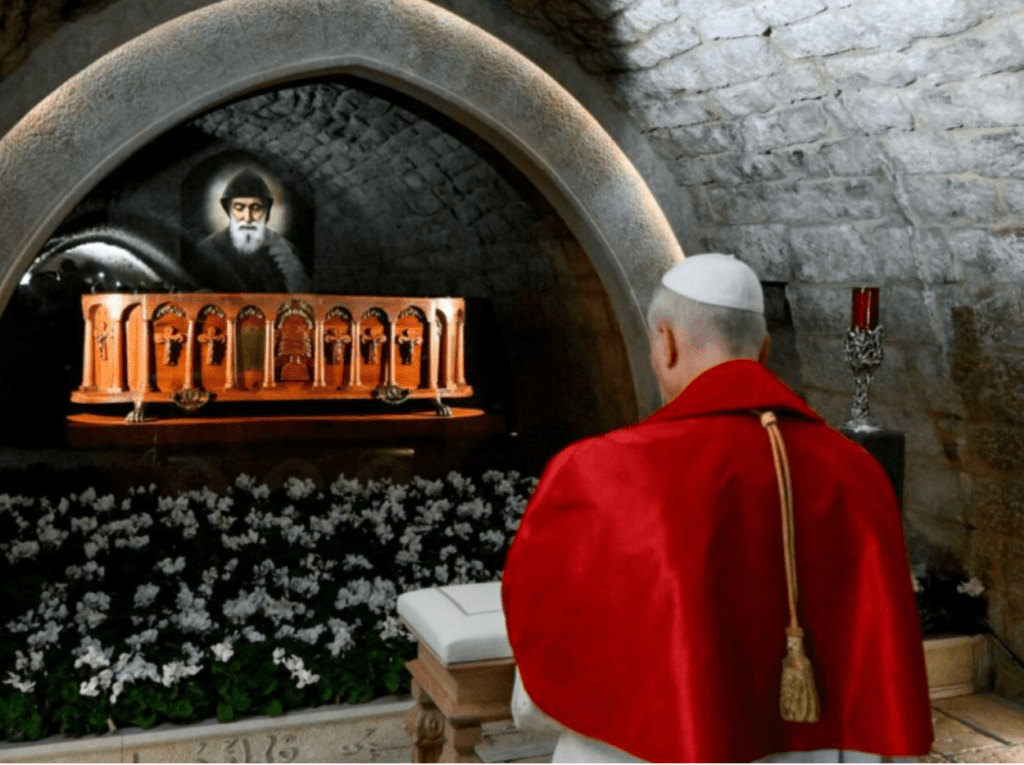
If we turn our gaze to Orthodox Christianity, we find an equally significant theological contribution. With the doctrine of theosis, the divinization of the human person, the Christian East insists that grace transfigures the entire person. Relics are thus perceived as testimony to the vocation of matter to glory. The light of Tabor does not illumine only the soul, but also the body of Christ and, by participation, that of the saints. This helps us understand why the use of relics in rites of exorcism is situated within this perspective: they are sacramentals that refer to the communion of saints and to the paschal victory of Christ, who always remains the center of the Church’s liturgical action.
In light of this long tradition, the exposition of the body of Saint Francis appears less surprising. The approximately 18,000 daily visitors contradict many simplistic readings of both Christian faith and devotion to the bodies of the saints. Precisely while modernity tends to reduce faith to private opinion or abstract ideality, thousands seek contact with the body of a saint. Here the body truly becomes a stumbling block to contemporary reductionism; it resists the reduction of faith to abstract ethics or disembodied spirituality. To dismiss the veneration of relics as a mere irrational residue is to fail to grasp its deep and living fabric within Christian Tradition.
In a time that oscillates between aesthetic idolization of the body and its radical functional devaluation, Christian tradition continues—always in an uncomfortable way—to propose the highest dignity of the human person as a creature loved and redeemed by God. Perhaps this is precisely what the bodies of the saints still proclaim today, drawing thousands of pilgrims to Assisi or wherever a saint’s body is entrusted to the Church’s memory. The intuition of holiness, passing through the body, mysteriously yet truly leaves a trace of the Light of God—visible footprints of His presence in history. In them, the divine shines forth, enduring in a virtue and light that traverse centuries and generations, and will continue to do so, in faith, until the end of the world.
 donfrancescomenichetti.com