Welcome, dear pilgrim, to this place where silence speaks and stone becomes prayer.
You stand on the slopes of Mount Loreto, about ten kilometers from the ancient city of Gubbio. You have walked along paths through oak woods and have reached the square shaded by imposing horse chestnut trees. You are most welcome, and I invite you to come into contact with the breath of a history whose roots reach deep into the centuries.
I am Father Francesco, parish priest of the Mocaiana Pastoral Unit, to which the parish of Loreto belongs. I entrust my ministry and our community to your prayer.
Before entering the church, I would like to share with you a few historical notes that will immerse you in the history of the land you are crossing. You are in the Eugubine countryside, within one of the most ancient dioceses of Christianity. To give just one example, the Diocese of Gubbio was already known in the 4th century: around 382 A.D., Saint Jerome, writing to demonstrate the equality of the successors of the apostles, chose it as a point of comparison: “Wherever a bishop may reside, whether in Rome, or in Gubbio, or in Constantinople… he has the same dignity and the same priestly rank…”
Moreover, in a letter from 416 A.D., Pope Innocent I further confirms that the Church of Gubbio was founded by those whom “the venerable Peter or his successors established as priests.” In the same letter, the Pope refers to the Eugubine diocese, its structure, and its parishes, already attesting in the 5th century to a well-organized Church.
Within this most ancient historical and ecclesial context, marked by a very long-standing tradition, stands the Parish Church of Loreto. Restored to the worship of the faithful in 2023, it is today one of the pastoral centers of the Mocaiana Pastoral Unit and the seat of the parish oratory.
I would now like to share with you some historical and artistic information.
The Exterior of the Church
The Portal
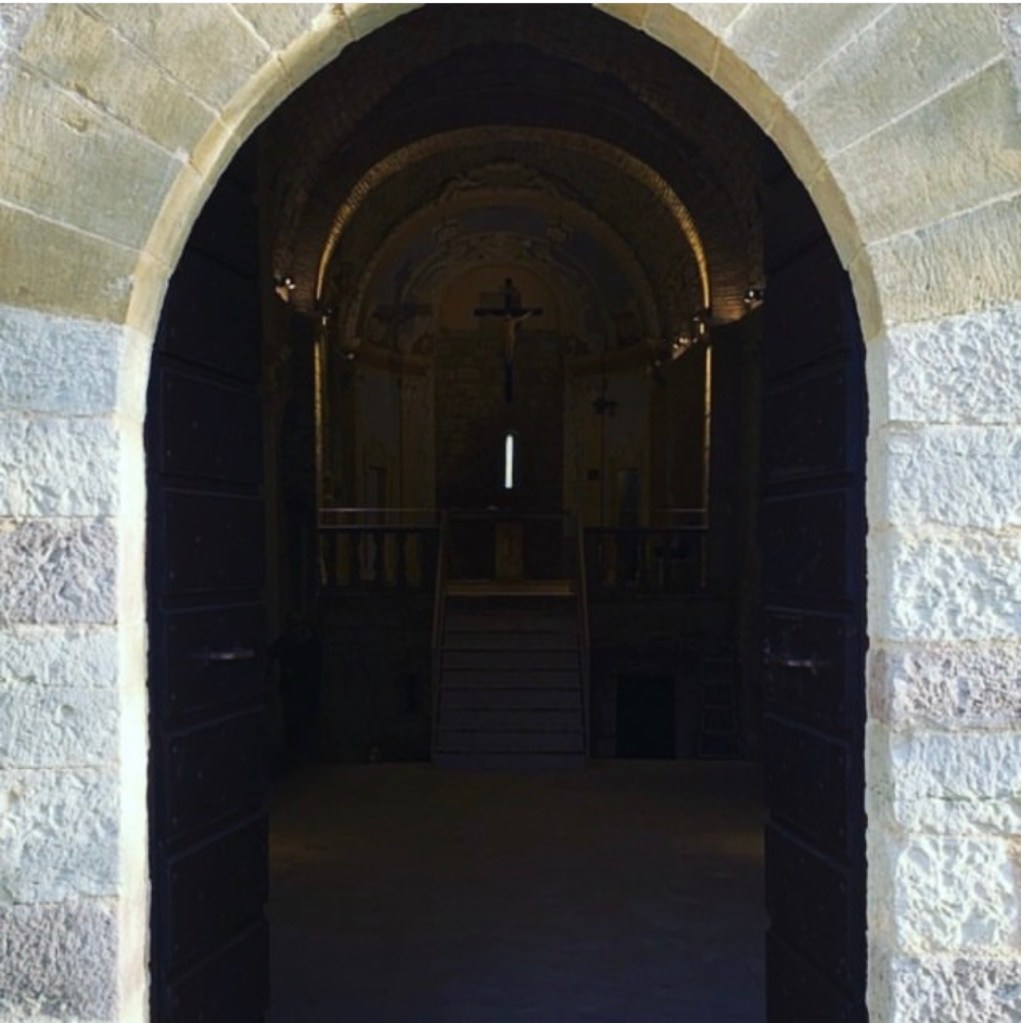
At the center of the façade opens a portal characterized by a pointed arch. The structure is made of simple, squared stone blocks, devoid of sculptural decoration, giving the entrance a sober yet solemn appearance.
The Masonry
The entire exterior surface is built with courses of local stone, particularly white and pinkish limestone. This chromatic alternation is typical of Umbrian architectural structures. On the right side of the church, you can notice the former rectory, now used as a parish oratory.
The Bell Tower
Originally, the façade was topped by a small bell gable positioned almost directly above the portal. However, during the renovations of the 17th and 18th centuries, it was removed and replaced by the current bell tower, built above the apse.
The Interior of the Church
The Interior
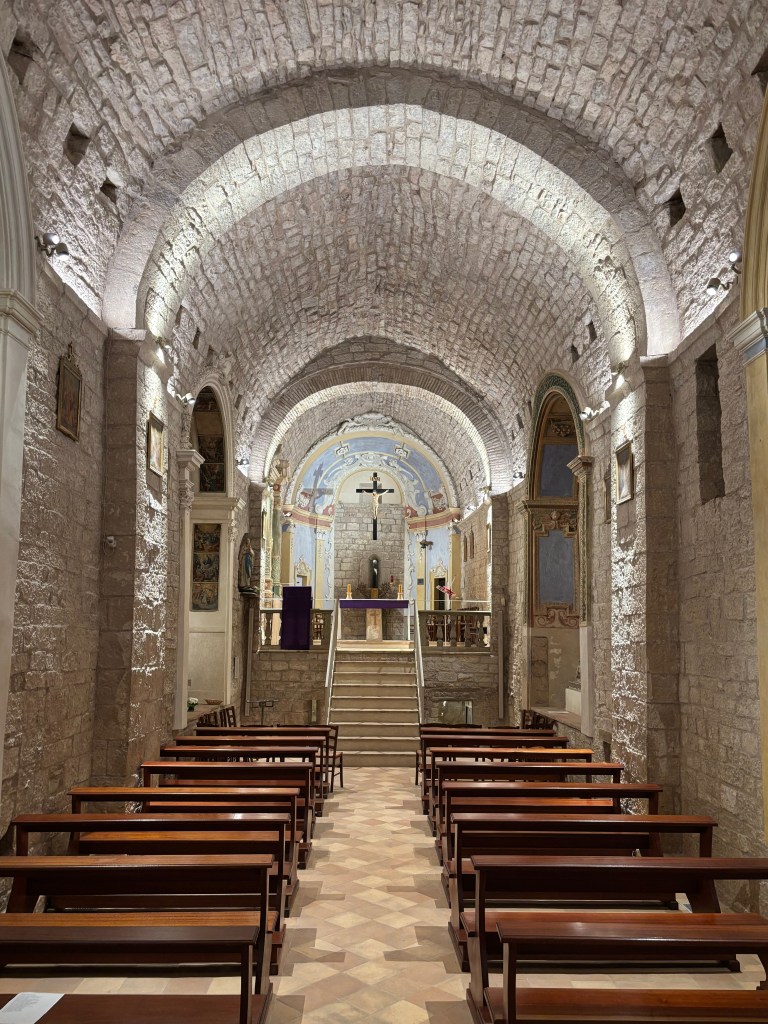
Having crossed the threshold of the pointed-arch portal, the church reveals a single nave in Romanesque style. The raised altar and a single east-facing window draw the gaze toward heavenly realities, indicating the path toward the Light of Christ, who enlightens every person with His light. Just beneath the window, the Blessed Sacrament is reserved. Entrust to Him your journey and the intentions of prayer you carry in your heart.
According to the sources that have come down to us, the present structure is the result of a reconstruction dating to 1233. Originally dedicated to Saint Stephen the Protomartyr, it was later re-dedicated to Saint John the Baptist following the renovations carried out in the 17th century.
On the left side of the nave:
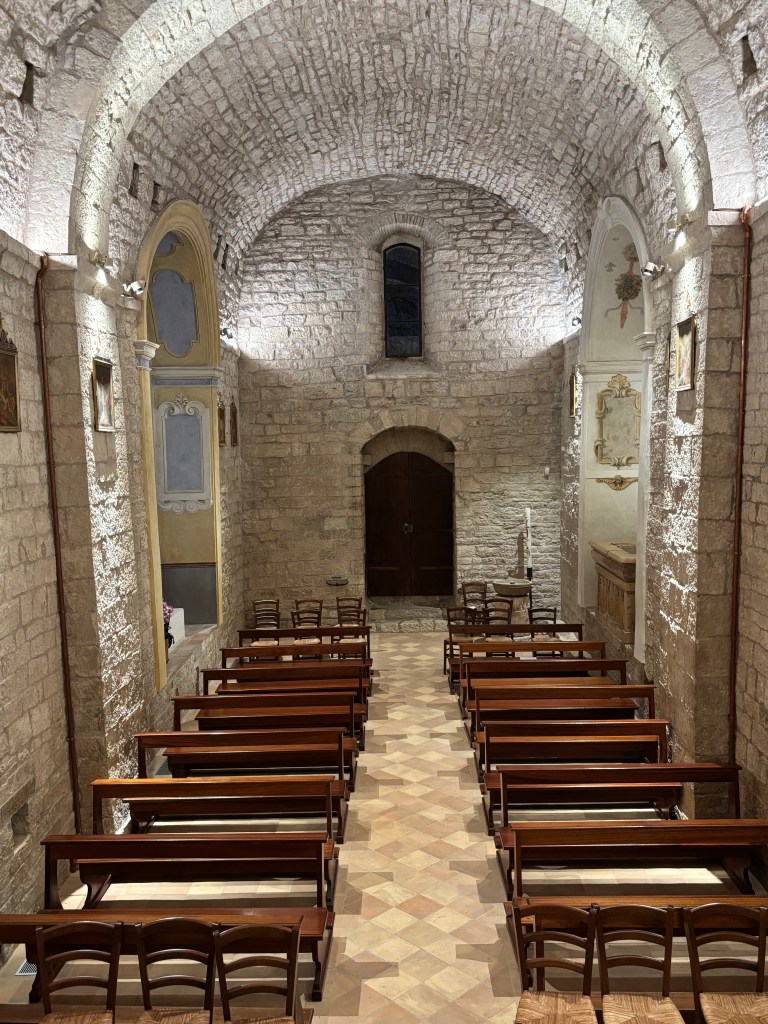
At the entrance on the left, you will find a Roman column with a basin, now used as a baptismal font. Moving forward, if you lift your gaze, you will encounter a jewel dating back to 1680, made of polychrome stone: it is the ancient baptismal font, in use until the first restoration works in the mid-20th century, which lowered the floor level of the church.
Above, a polychrome plaster bas-relief depicts the Baptism of Jesus in the River Jordan by John the Baptist. This church is a pieve, meaning that since ancient times it possessed the only baptismal font for a very large territory, collecting tithes from all the surrounding communities.
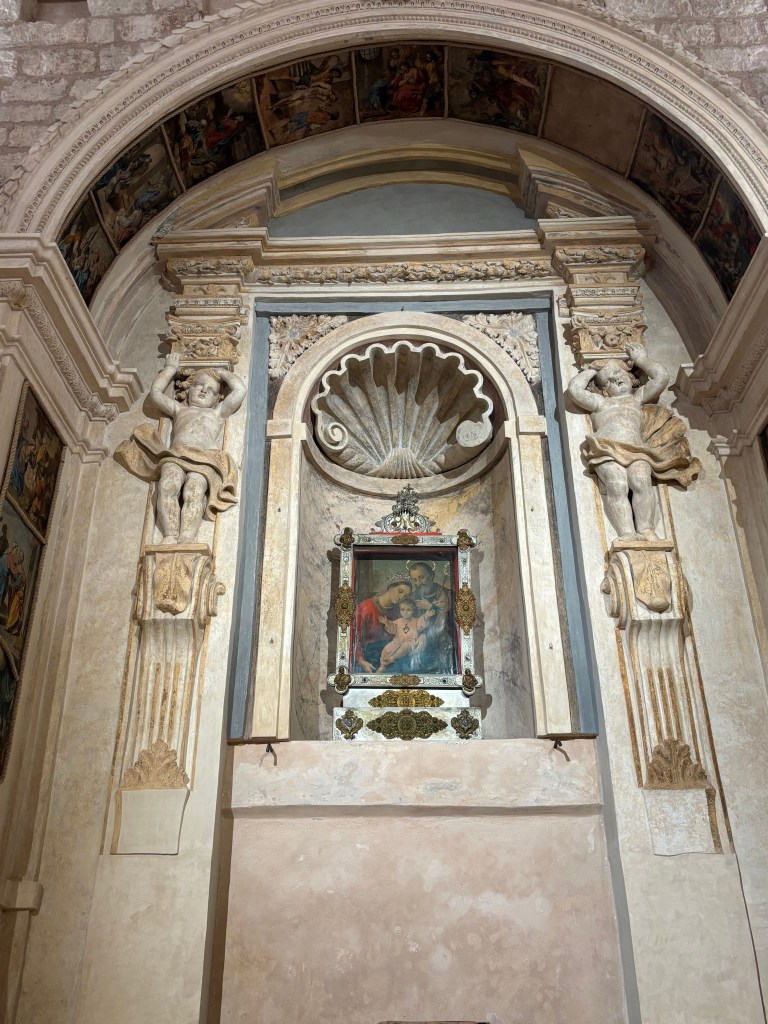
Continuing along the left side, you will find the Altar of the Holy Family. In the niche at the center of the wall is an image of the Holy Family of Nazareth. The niche is framed by fourteen 17th-century paintings on panel illustrating the Mysteries of the Rosary. Recently restored to their original splendor, they recount the mysteries of the Holy Rosary.
Beginning on the left with the Joyful Mysteries:
- The Annunciation of the Angel to the Virgin Mary
- The Visitation of the Blessed Virgin Mary to Saint Elizabeth
- The Birth of Jesus in the cave of Bethlehem
- The Presentation of Jesus in the Temple
- The Finding of Jesus in the Temple
Then five related to the Sorrowful Mysteries:
- The Agony of Jesus in the Garden of Gethsemane
- The Scourging of Jesus at the Pillar
- The Crowning with Thorns
- The Ascent of Jesus to Calvary carrying the Cross
- The Crucifixion and Death of Jesus (lost)
Then five related to the Glorious Mysteries:
- The Resurrection of Jesus
- The Ascension of Jesus into Heaven
- The Descent of the Holy Spirit upon the Apostles and the Virgin Mary in the Upper Room
- The Assumption of the Virgin Mary into Heaven
- The Coronation of the Virgin Mary as Queen of Heaven
On the right side of the church nave:
Continuing from the entrance toward the presbytery, you will encounter the first altar, dedicated to Saint Sebastian.
Here your gaze meets an 18th-century painting attributed to Orazio Morotti (1660–1723). On the wall is a canvas depicting the Virgin Mary above a radiant halo, surrounded by groups of cherubs. With her left hand, the Madonna lifts her mantle to protect a small child clinging to the belt fastened around her waist.
In the foreground, two saints are represented: on the right, Saint Anthony Abbot, depicted in pontifical vestments (mitre, cope, and pastoral staff), accompanied by his traditional symbols—the fire and the pig at his feet; on the left, Saint Sebastian, dressed as a Roman soldier, holds the palm of martyrdom, also recalled by the quiver of arrows placed at his feet.
The painting, datable to the 18th century, measures 206 × 141 cm. It is not, however, the same canvas described in the pastoral visitation of 1636, as Saint Matthew—mentioned in that report—is not depicted here.
The altar belonged to the Confraternity of the “Cinturati of Saint Augustine and Saint Monica,” who, from May 14, 1745, venerated here the Virgin under the title of Madonna of Consolation. “Mother of Consolation” or “Madonna of the Belt” is the principal title under which the Augustinian Order has honored the Virgin since at least the 17th century. In 1439, the Order received permission to establish lay “Confraternities of the Belt.”
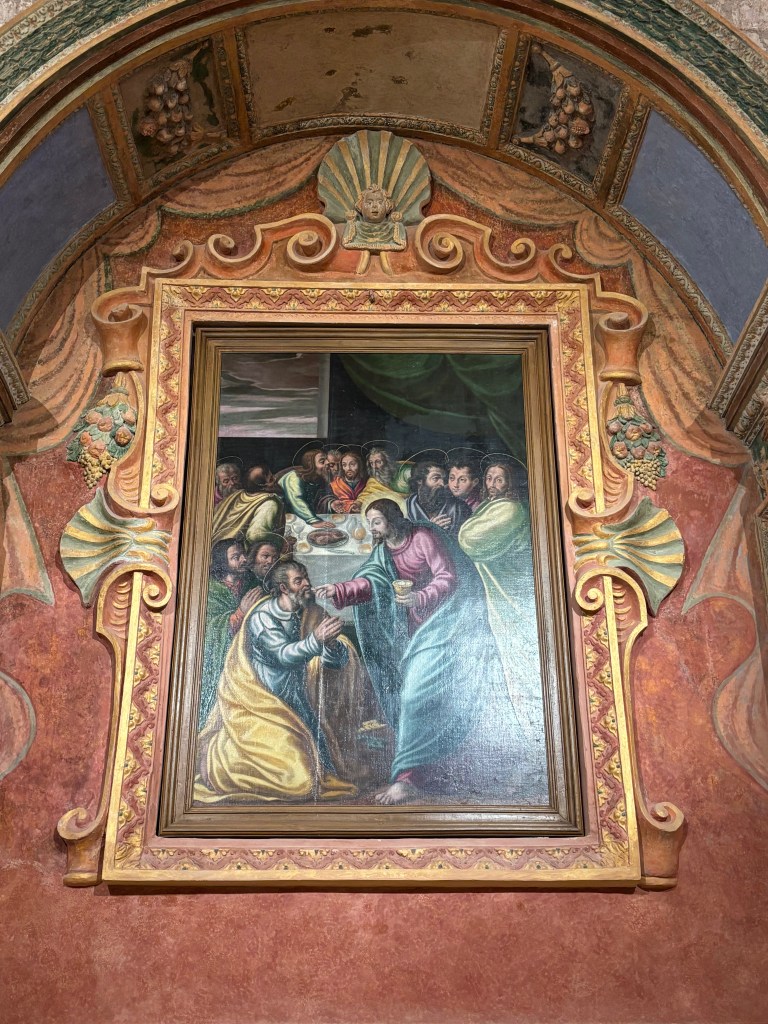
At the second altar, you will find the painting of the Communion of the Apostles, attributed to Virgilio Nucci.
The canvas, datable to around 1600 and measuring 189 × 128 cm, was recently restored. It was exhibited on the occasion of the 25th National Eucharistic Congress, held in September 2011 in Ancona, within the exhibition “At the Lord’s Table – Masterpieces of European Art from Raphael to Tiepolo”, organized at the Mole Vanvitelliana.
The composition devised by Nucci is very close to the panel by Giuliano Presutti (c. 1540) in the Church of San Domenico in Gubbio, especially in the depiction of Christ as priest administering Communion to Saint Peter. However, Nucci arranges Judas differently, showing him from behind, holding the bag of coins in his right hand, while the apostles around the table converse among themselves.
The restoration of the altarpiece confirmed Nucci’s preference for vivid tonal colors. The stucco altar frame is decorated with a festoon motif of leaves, continuing along the extrados of the arch, and with vegetal scrolls on the supporting pilasters. The intrados is adorned with six coffers, two of which feature reliefs with fruit garlands. On the inner sides of the pilasters are two panels framed in relief and surmounted by angelic heads. The architectural moldings are further enriched with egg-and-dart patterns and volute decorations incorporating shell elements and clusters of fruit. Particularly noteworthy is also the restoration of the back wall of the chapel, which brought to light the original colors of the drapery and the rich stucco decoration of the frame. On the altar mensa stands a statue of Saint Anthony Abbot, made of molded plaster, painted and gilded. The altar belonged to the Confraternity of the Blessed Sacrament, which had four priors: one from Loreto, one from Piazza, one from Coltortora, and one from Carbonana. In 1636, the confraternity counted two hundred members, both men and women.
The Apse
The apse is entirely decorated with four pilasters adorned with Corinthian capitals, fruit garlands, and vegetal scrolls, which frame the plastered surface. The apse basin, set upon an entablature with polychrome molded cornices, features a coffered decoration with rosettes and festoons on the section facing the altar, while the inner section is adorned with a cherub’s head set within a cartouche between volutes and two lateral cornucopias.
The outer arch of the apse is decorated with a vegetal festoon, interrupted at the center by a cartouche with putti. The new altar has been made using reclaimed materials from the crypt, incorporating an original stone base.
The Aedicule of Our Lady of Sorrows
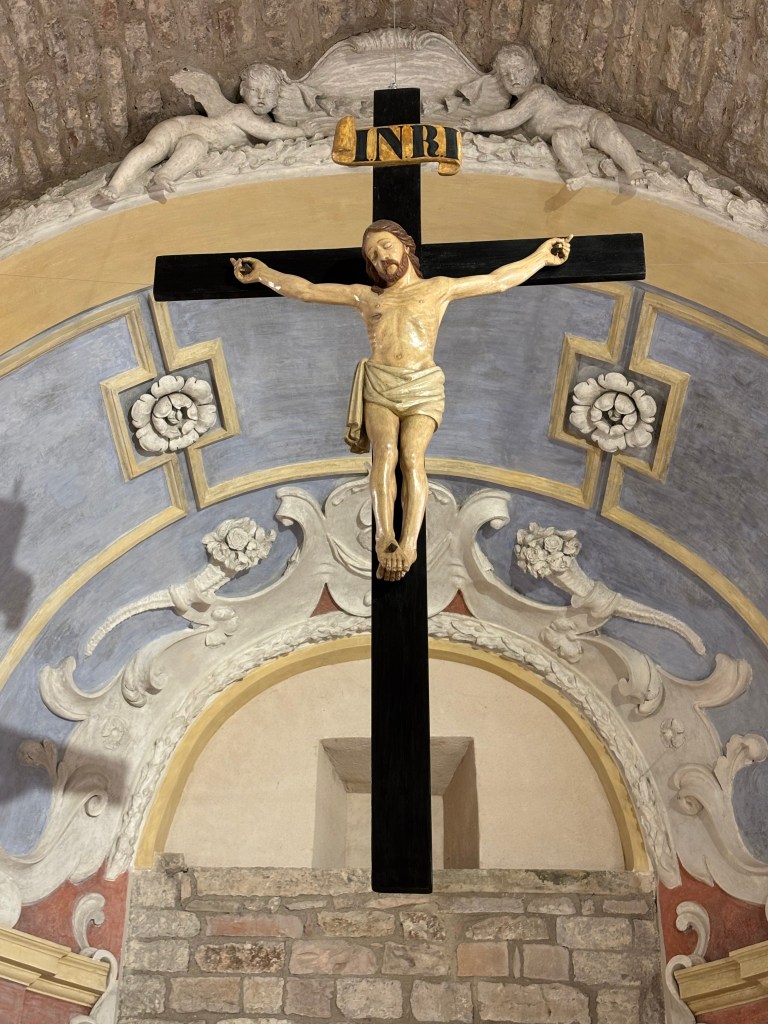
On the left side of the presbytery stands an aedicule, at the center of which is a wooden statue depicting Our Lady of Sorrows, a work produced by a renowned workshop in Ortisei, by the sculptor Giacomo Vincenzo Mussner. The altar structure is framed by two fluted columns with Corinthian capitals, set on stylobates decorated with relief heads of putti and vegetal scroll motifs at their base. The niche is surrounded by a frame with egg-and-dart and pater nostermotifs, which are also repeated in the entablature moldings, themselves adorned with vegetal scrolls and winged heads. The upper crowning is a broken pediment, at the center of which is a finial bearing the image of the pelican. On the inner side walls, within stucco frames, are depicted the figures of sorrow: the Virgin Mary on the left and Saint John the Evangelist on the right. The presence of these two figures confirms that this space was originally the Chapel of the Crucifix, owned by the Society of the SS. Rosarum, whose emblem—the pelican—is represented at the top center of the frame.
The Thousand-Year-Old Crypt
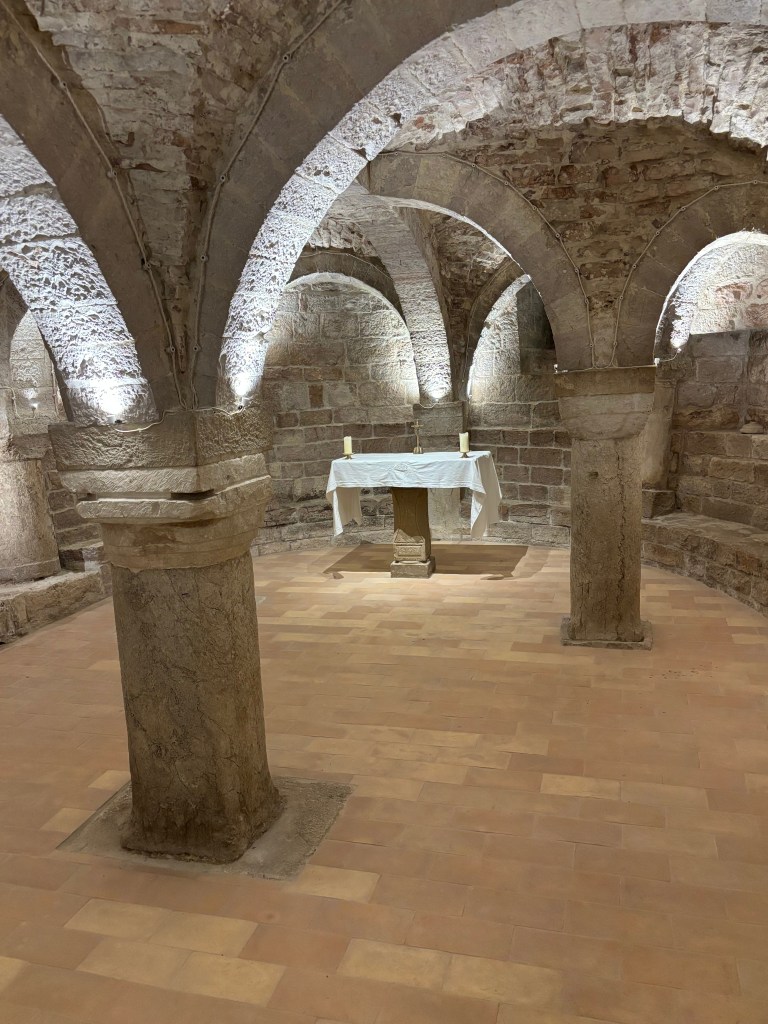
Now, pilgrim. On your right you will find the entrance to the crypt, the oldest and most fascinating part of the entire building.
The crypt is accessed through a side opening on the right, beneath the raised presbytery. It is the oldest part and, according to many scholars, the most significant of the whole structure. Before entering, you can admire the bas-relief decorations of the staircase, formed by a lattice containing roundels with floral and abstract motifs, as well as the door lintel, adorned with geometric and floral designs.
The stone beneath the staircase is part of a large 9th-century pluteus (in Christian religious architecture, a pluteus divided the various sections of a church, usually marking off the presbytery and the choir). This is an important testimony, brought to light during the restoration carried out by Don Corrado Antonelli, confirming that an earlier church once stood on this site, much older than the present one. The decorated lintel of the doorway, with geometric and floral motifs, dates from the same period.
Upon entering, you encounter a space of remarkable beauty and great charm—without doubt the most evocative part of the church of Loreto. It has a quadrangular plan with a semicircular apse, whose curvature is not visible from the outside as it is contained within the thickness of the wall. The vaults are groin vaults supported by twelve columns, some of which are incorporated into the later walls of the church built above.
The columns, all reused from Roman buildings of different origins, are made of white limestone, except for two—one in marble and the other in grey granite. The capitals are shaped like inverted truncated pyramids, with roughly sketched heads at the corners. Three low pillars, arranged in two alignments, support the groin vaults of the ceiling, which discharge onto semi-pillars or small engaged columns along the walls. A strong rib springs from the first pillar and reaches the curved wall of the apse, intersecting with the central arch system of the second alignment. The space is thus articulated first into two, and then into three small aisles.
When Don Quirico Rughi wrote about it in Il Messaggero in 1954, the space appeared very different from today: it was buried up to half its height, without an altar, and with a rectangular basin visible on the floor. The presence of this basin led to the hypothesis that the structure may have been used as a baptistery for immersion rites. This hypothesis is plausible, considering that from at least the 13th century the church served as the baptismal center for a wide surrounding territory.
The dating of the crypt remains debated. Some scholars identify features comparable to other Umbrian crypts of the mid-11th century; others consider it contemporary with the 13th-century reconstruction of 1233. In any case, it clearly precedes, in conception and layout, the current arrangement of the upper nave.
A significant element, as in the church above, is the presence of a single east-facing window. The morning light enters the crypt in a measured way, enhancing the architectural structure and emphasizing its symbolic dimension. In 2024, the crypt was reopened to the public after a restoration that restored its original layout, clarified the spatial organization, consolidated the structures, and brought to light its medieval configuration. Today it is once again accessible as an integral part of the church’s visitor path.
The crypt represents the oldest and most meaningful core of the church: an intimate and essential space that preserves traces of Roman reuse and bears witness to the long historical stratification of the site.
Here, in the silence of the stones, you can feel the continuity of history. Before setting out again, remember that Saint Francis also walked these paths on his journey toward Gubbio, coming from La Verna and often heading toward Assisi. May his spirit of peace accompany you on your way.
Preghiera di benedizione del pellegrino
Lord God,
who accompanies the steps of those who set out on a journey,
look with kindness upon these pilgrims of yours.
Along this Franciscan path,
amid fatigue and wonder,
sustain their steps
and guard their hearts.
As the light that rises from the East
guides the journey of all people,
so may your grace
illuminate their path
and renew in them the joy of Baptism.
In weariness, grant strength;
in uncertainty, grant trust;
in the silence of the journey,
let your Word resound.
Through the intercession
of Saint Stephen the Protomartyr,
of Saint John the Baptist,
and of Saint Francis of Assisi,
grant to these pilgrims
peace in their hearts,
protection along the way,
and perseverance in what is good.
Amen.
Ringrazio Paolo Salciarini per la collaborazione
 donfrancescomenichetti.com