
Welcome to this Romanesque jewel of the Eugubine territory, where history, faith, and landscape intertwine along a path rich in memory.
Leaving Gubbio in the direction of Umbertide, one follows Regional Road no. 219, known as Pian d’Assino after the river that runs parallel to the route. Along the way, one encounters remarkable architectural landmarks and historical sites: the tower of the ancient mill of Sant’Angelo d’Assino, the castle of Carbonana, and the tower of the ancient church of Sant’Angelo. Continuing on to the hamlet of Camporeggiano (approximately 14 km), one turns left towards Montelovesco; after crossing the bridge, a large building immediately comes into view, now unfortunately in a state of disrepair: this is the ancient monastery of San Bartolomeo (now privately owned), situated at the foot of a modest hill upon which stand the significant ruins of the castle of Monte Cavallo. In the early 10th century, this castle was the residence of the Counts Gabrielli, one of the most illustrious and ancient noble families of central Italy.
Near the monastic complex, the church of the same name was built (today a parish church), counted among the most significant Christian monuments of the Diocese of Gubbio for its historical value and architectural quality: a true jewel of the local Romanesque style.The monastic complex and the church are also documented in historical cartography. In the Map of the Diocese of Gubbioby U. Giorgi (1574), the locality of Camporeggiano is already described with its main reference points, including the monastery and the church. The same features reappear in the cadastral maps of Gubbio drawn by Ghelli between 1759 and 1767, in the map entitled Camporeggiano.
The drawing reproduced in Adolfo Barbi’s atlas, Geographical Atlas of the Territory of Gubbio in the 1700s, confirms the continuity of the site’s memory and its significance within the territorial system of the Assino valley, in relation both to transit routes and to the presence of monastic institutions and fortified strongholds.
ESSENTIAL HISTORICAL NOTES
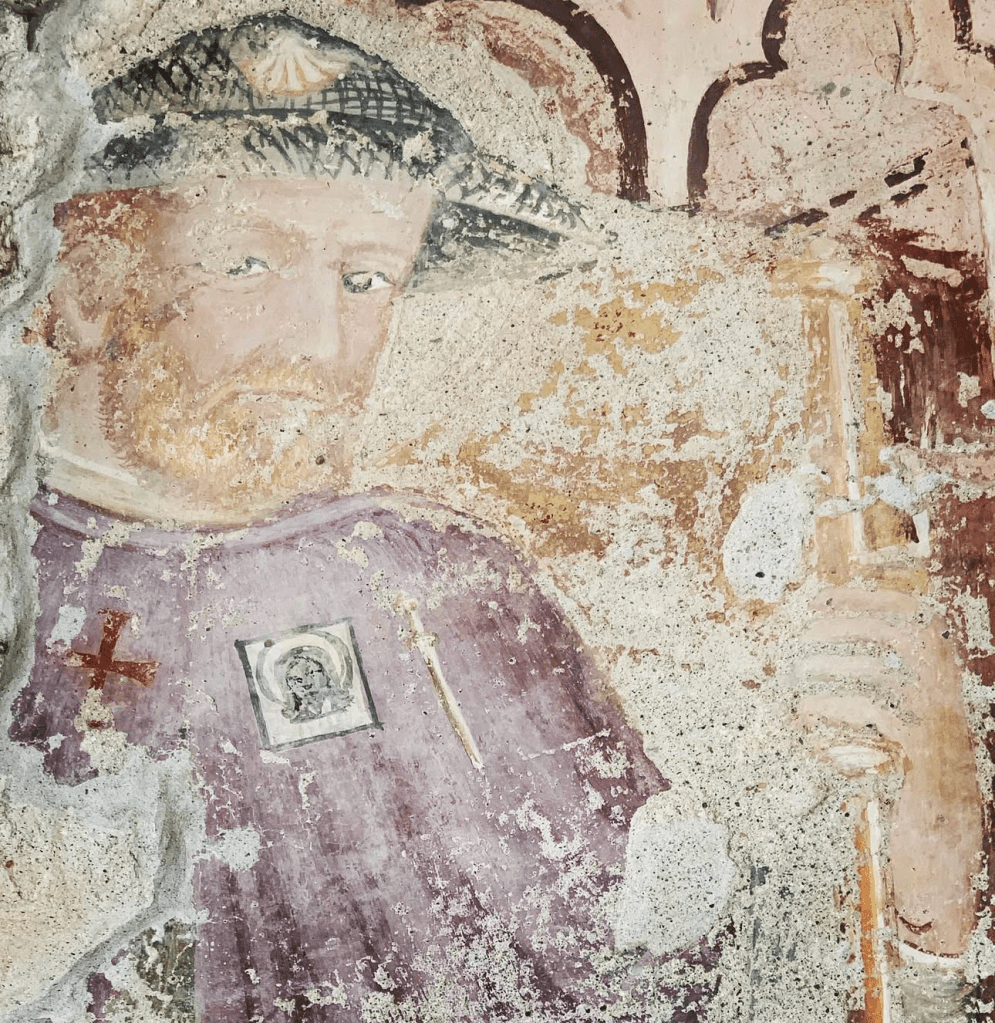
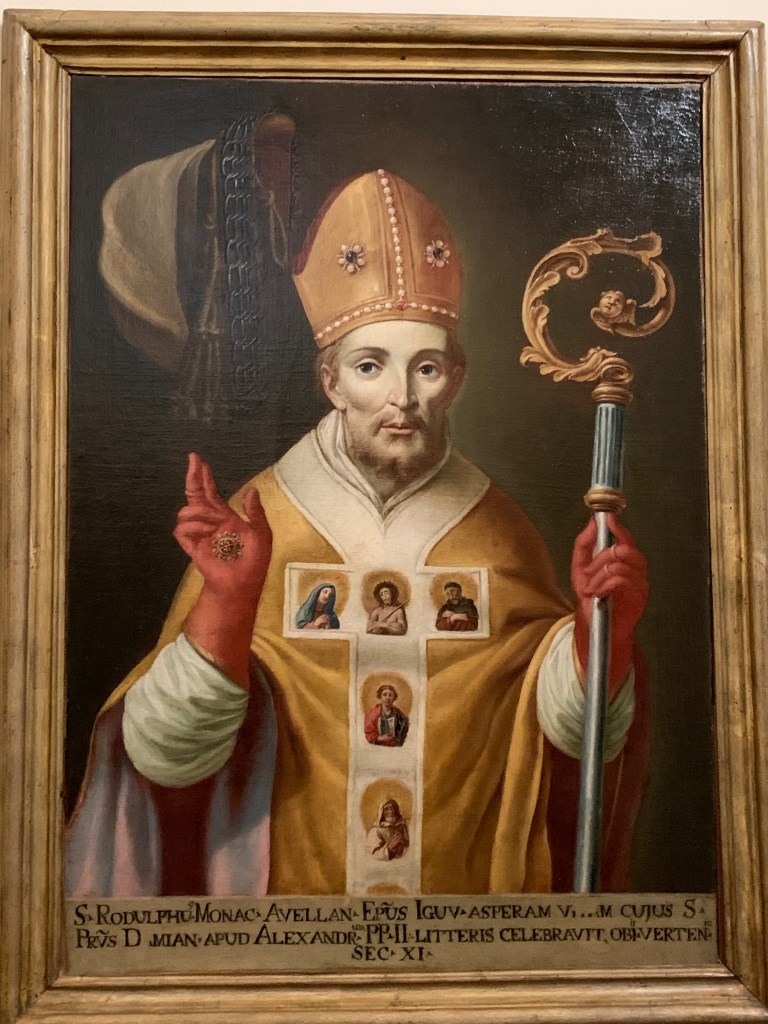
In 1057, Rozia, together with her sons Pietro, Giovanni, and Rodolfo Gabrielli, donated to Saint Peter Damian—then a monk and later prior of Fonte Avellana—properties including the castle of Monte Cavallo, the villa of Camporeggiano with its church, and other plots of land, with the explicit aim of founding a monastery “in honore sancti Bartolomei apostoli.” Among Rozia’s sons, Rodolfo Gabrielli stands out: after his monastic experience at Fonte Avellana, he was elected Bishop of Gubbio (1059–1064). Local tradition remembers him as a figure of notable spiritual and pastoral importance, to the extent that he is venerated as a saint within the Eugubine context. His story attests to the deep connection between the emerging monastic institution of Camporeggiano, the hermitage of Fonte Avellana, and the episcopal see of Gubbio.
The monastery and church were built by the Avellanite monks and soon received endowments and privileges. Pope Nicholas II granted various lands in the locality of Burano, while on 25 January 1063 Pope Alexander II placed the cenobium under apostolic protection. In 1065 further grants and exchanges of land with the episcopal see of Gubbio are recorded, accompanied by the clause that the monastery should not separate from the “charitate heremi Fontis Avellane.” On 24 May 1139, Innocent II confirmed among the Avellanite possessions the monasterium sancti Bartolomei de Camporegiano. Between the 12th and 13th centuries, the cenobium reached considerable importance, exercising jurisdiction over numerous monasteries in the Umbrian-Tuscan area and over a wide network of dependent churches.
In 1419, due to wars and the severe state of ruin of the buildings and properties, the abbot—together with Count Guido da Montefeltro—requested from Pope Martin V the renunciation of the abbey’s dignity. With the bull Ad hoc circa, the abbey was suppressed and united to San Donato della Foce of the Olivetan monks. In 1523, Clement VIII confirmed this union. Gradually, the religious community moved to other monasteries until, in 1653, Innocent X recalled the last monk to enclosure; in 1658 the church was secularized and declared co-parish of San Michele Arcangelo di Sioli. A residual presence is still attested in 1730 with the lay brother Fra Benedetto Tosi. The monastic presence definitively ceased in 1861 following the laws suppressing ecclesiastical property (for Umbria: the Pepoli Decree, 1860).
The complex subsequently passed into the hands of various private owners and was progressively abandoned. On the right side of the abbey, the austere bell tower is still visible, truncated in the years immediately following the Second World War for safety reasons. Today, the monumental complex, now in a condition close to collapse, awaits a conservation intervention that may restore dignity to one of the most significant historical sites of the Eugubine territory.
THE “PRODUCTIVE SEASON”: GLASSWORKS AND KILNS
A distinctive element in the history of Camporeggiano is the presence of proto-industrial activities. Around 1500 (according to some hypotheses, at the end of the 18th century), a glassworks was established, founded by a Dutch monk and capable of reaching considerable production levels (approximately 700 glass panes per day). As a flux, soda obtained from the ash of riscoli or agretti (Salsola soda), cultivated along the Assino River, was used, while the vitrifiable material consisted of flint stone from Gubbio.
Around 1680, a brick kiln was also in operation. According to P. L. Menichetti, in 1682 the production included: 12,000 roof tiles, 2,000 floor tiles, and 7,000 bricks of both thin and thick types. These data attest to a significant economic vitality of the site in the early modern period.
SAINT BARTHOLOMEW THE APOSTLE
The church is dedicated to Saint Bartholomew, counted among the Twelve Apostles. The Gospel of John presents him in connection with Philip, who brings him to encounter Jesus. Tradition attributes to him an intense missionary zeal directed toward various regions of the Middle East. As for his death, the sources diverge, but tradition speaks of martyrdom by flaying.
His cult spread widely throughout the Christian world, and his liturgical memorial is celebrated on August 24. Numerous churches in the Diocese of Gubbio were dedicated to the apostle, a sign of a particularly deep-rooted devotion in the area. According to a local tradition, some relics were brought on pilgrimage to the crypt, where they remained for several months before being returned to Rome.
RECENT HISTORY AND RESTORATION
During the pastoral visit of 1592, Bishop Mariano Savelli ordered interventions concerning the chapel beneath the high altar, namely the crypt. In 1696, the church was recorded as belonging to the monastery of San Pietro; on the high altar there was a painting depicting the Madonna, Saint Bartholomew, Saint John, Saint Ubaldo, and Saint Bernard.
Between the 17th and 18th centuries, once it had become a subsidiary church, it underwent significant alterations: the side aisles were closed, the central nave was shortened, and the crypt was modified.
In 1959, with the arrival of Don Romano Bambini and thanks to the Superintendency of Perugia, major restoration works began; in 1969 the crypt was reopened. The right nave remained closed until 2005, when—thanks to the donation of Engineer Franco Sacchetti (deed dated 18/12/1987)—it was possible to complete its restoration under the direction of the Eugubine architect Augusto Solano.
The transfer of the parish title to Camporeggiano was formalized by decree of the President of the Republic on 27 September 1965.
ARCHITECTURAL FEATURES
The church has a basilica plan with three naves, a raised presbytery, and a crypt beneath. The naves, covered with wooden trusses, are divided by arcades resting on sturdy quadrangular pillars. The circular apse, devoid of single-lancet windows, receives light mainly from the oculus on the façade.
Above the altar in the presbytery stands a wooden crucifix originating from the same church, restored in 2018 by M. Cristina Vinciarelli. Within the church there are also a wooden statue of Our Lady of the Rosary, one of Saint Bartholomew, and an icon depicting Christ Pantocrator together with saints connected to the history of the Abbey.
THE CRYPT
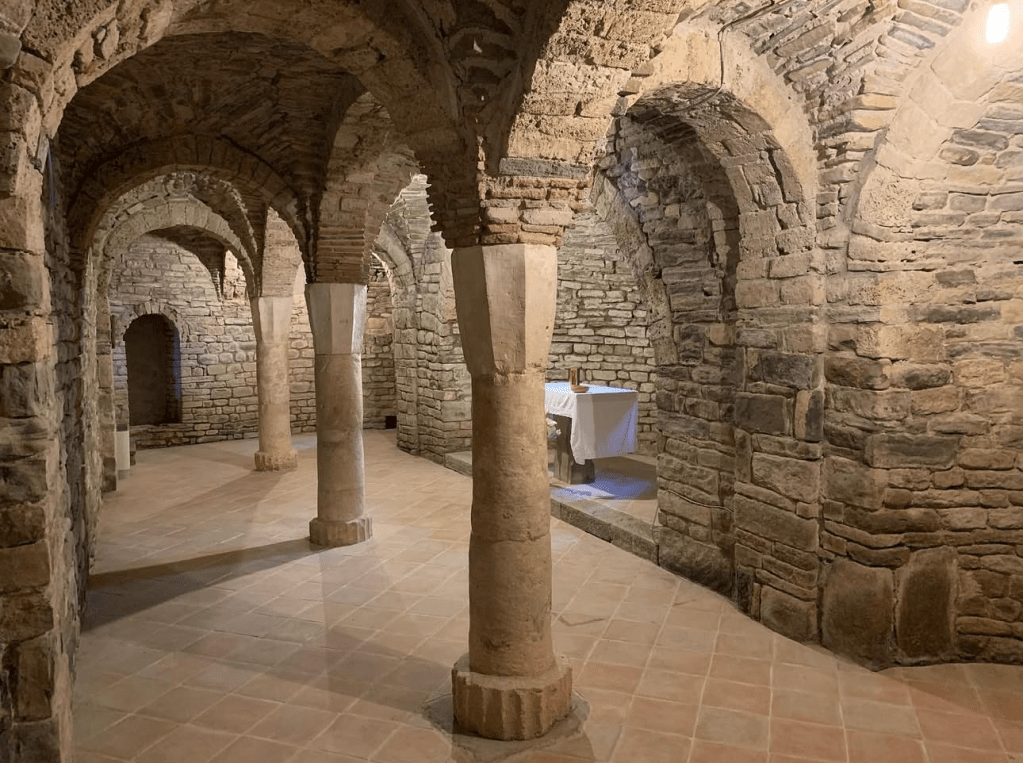
One of the oldest and most evocative elements of the complex, the crypt of San Bartolomeo constitutes the most archaic architectural core of the church. It is dated by G. Martelli to the first half of the 11th century, thus closely connected chronologically with the founding Avellanite phase.
The space has a rectangular plan and is divided into three naves of two bays each, covered by groin vaults. The internal articulation is entrusted to three reused columns, probably originating from earlier structures; their shafts are chiseled up to about one fifth of their height, leaving the fluting visible only in the lower section. This workmanship, beyond responding to structural adaptation needs, gives the space a character of austere essentiality.
Particularly noteworthy are the inverted truncated-pyramidal capitals, of Ravennate taste—a typology not common in the Eugubine area and indicative of craftsmen familiar with models of the early Adriatic Middle Ages. The crypt ends with three semicircular apses, not perfectly aligned with the upper apse of the church, suggesting a different construction phase.
On the left wall, one can still see the blocked arch of a doorway that once led to a monastic oratory now lost, likely obliterated when the modern road to Montelovesco was opened in the post-war period.
PRAYER TO SAINT BARTHOLOMEW THE APOSTLE
O glorious Saint Bartholomew,
faithful witness of the Gospel
and disciple who followed the Lord
with a free and courageous heart,
turn your gaze upon us.
You who proclaimed Christ
to the ends of the earth
and gave your life in martyrdom,
teach us fidelity in trials,
perseverance in daily labors,
and the joy of belonging to the Lord.
Bless all visitors and faithful,
watch over those who enter in silence,
support the families of our land,
and guide the steps of those who seek God.
Grant that, like you,
we too may recognize the Master
along the paths of life
and follow Him with an undivided heart.
Amen.
 donfrancescomenichetti.com